
Lyon County Most Wanted Profiles
The Lyon County Sheriff's Most Wanted index works like a bulletin board. The sheriff picks a handful of people and posts their photos for the public. Each tile carries a picture. Clicking one opens a fuller profile. Among the county's roster, arrest report, warrant, and wanted resources, this is the only sheriff web channel that routinely shows face images. The count of profiles shifts over time. There is no posting schedule and no update promise. Entries can change or vanish without notice. The screenshot below shows the official index interface itself, without republishing any individual booking photo as a local gallery.

Think of the index as a curated notice from the sheriff, not a full warrant database or a substitute for the current jail roster or a court docket. Each wanted profile reflects a claimed warrant basis captured at one moment.
Lyon Wanted Listing Fields
A typical profile carries enough detail to support recognition. Expect a photograph. Physical traits come next, along with a last known address. Read every field in context, though. That address is historical information, not an invitation to visit. The charge line names the offense tied to the notice. The bond figure relates to the warrant, nothing more. For anything binding, the warrant report and the court docket still control.
| Field | What the sheriff profile shows |
|---|---|
| Photograph | An official image used for recognition on the sheriff-hosted page. |
| Physical description | Race, hair color, eye color, and age shown on the sampled profile. |
| Last known address | A previously reported location that may no longer be current. |
| Charges | The alleged offense or offenses tied to the wanted notice. |
| Bond | The amount stated on the profile, subject to later court action. |
Two Lyon County Warrant Lists
Lyon County puts out two separate warrant products. They are not interchangeable. The Warrant List PDF runs about ten pages and contains no photographs. It is the broad name-check route. The smaller wanted index, by contrast, highlights a selected set of people along with their pictures. Someone can appear in the warrant PDF without ever showing up among the featured wanted profiles.
| Source | Coverage | Photo | Best use |
|---|---|---|---|
| Warrant List PDF | Broader generated county report | No | Checking a specific name and warrant details |
| Most Wanted index | Curated subset selected by the sheriff | Yes | Recognition and safe location tips |
| Iowa Courts Online | Public docket events in the underlying case | No | Following court status and disposition |
The warrant report carries a timestamp but no stated refresh cycle. Its fields run long: warrant number, name, issue and disposition dates, warrant type or section, date of birth, sex, race, height, weight, hair, eyes, charge, bond, and disposition. Those details do real work. They help separate people who share a similar name. Even so, remember that the public PDF is a generated report rather than a live query, so details still need confirmation.
Check a Lyon County Warrant
Start with the broad report before the photo index when checking a specific name. The whole point is verification and lawful resolution. Nothing here advises on avoiding service or arrest.
- Open the official Warrant List PDF and read its generated timestamp.
- Use the browser’s find command for the full surname, then match the first name and birth date.
- Read the warrant number, issue date, type, charge, bond, and any disposition field together.
- Confirm current status with the sheriff’s warrants contact or the court before relying on the report.
- If the warrant may concern you, contact an attorney and the responsible court or sheriff to arrange a lawful response.
Sergeant Alex Waagmeester is the published warrants investigator contact at 712-472-8311. For general non-emergency matters, dispatch answers at 712-472-8300. The Lyon County Sheriff's Department sits at 410 S. Boone St., Rock Rapids, IA 51246. When the generated report leaves the question open, a focused records request can ask about an existing warrant record directly.
- Arrest warrant
- A court-authorized order tied to an alleged offense.
- Bench warrant
- An order commonly issued after a person does not comply with a court requirement.
- Disposition
- The recorded action or outcome, which may change the current force of a listed warrant.
Use Lyon Wanted Records Safely
The wanted index exists to help people recognize a face, not to power private investigations. Keep that line firm. Photographs, physical traits, and last known areas can all be stale. Never visit an address, follow someone, attempt a detention, or post an unverified sighting online. If there is immediate danger, call 911 right away. Otherwise, use dispatch or the official tip form. Let trained officers size up the report.
- Open the sheriff-hosted wanted index and confirm that the profile is still present.
- Compare only what you already know with the official photograph and description.
- Note the place, time, and concrete facts without confronting or alerting anyone.
- Call dispatch or submit the information through the sheriff’s fugitive-tip channel.
- Use the Lyon County arrest and roster sources later if the sheriff reports a booking.
Lyon County Fugitive Tips
The official Lyon County crime-tip form includes a Fugitive Tip category. A name is optional, according to the form itself. Submitted information is treated confidentially. One caution stands out: the form is not monitored around the clock. Those statements describe the channel carefully without making it technically anonymous. The captured view below shows the sheriff-controlled tip route and its emergency warning.
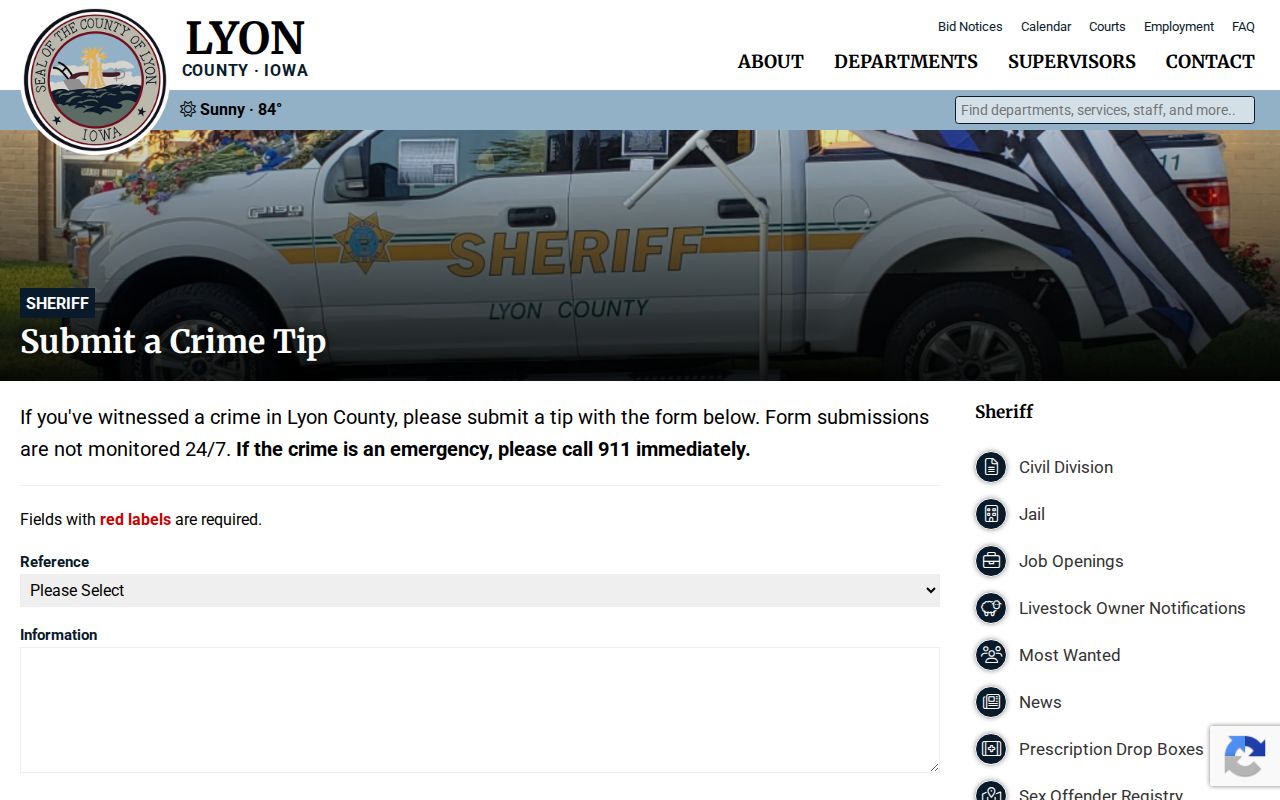
The sheriff promises no reward and lists no Crime Stoppers partnership on the wanted or tip pages. So expect no payment, invent no reward, and never send urgent information through a web form.
Lyon County Sheriff’s DepartmentNon-emergency dispatch: 712-472-8300
Warrants investigator: 712-472-8311
Emergency: 911
Online: official Submit a Crime Tip form
Lyon Wanted Record Freshness
The sheriff posts no update schedule. There are no posting dates, no reward program, and no systematic booking-photo feed. An official Facebook profile is linked from the sheriff's site, but there is no basis to assume every warrant, arrest, or wanted profile lands there. Social posts get edited or deleted too. The official website plus direct confirmation remains the stronger path.
One more trap exists for mobile users. No sheriff app exists for Lyon County, Iowa. App-store searches often surface Lyon County, Nevada. That one belongs to a completely different government and should never be used for Iowa warrant information. Anyone on a phone can simply open the official PDFs and web pages in a browser. Check timestamps, and confirm with dispatch or the court whenever current status matters.
After a Lyon Warrant Listing
Catch someone on the wanted list and the next stop is often the Lyon County Jail. The listing itself will not tell you that. For who is actually confined right now, the current-inmate report is the tool to use. The arrest press log works differently. It can hold details of a recent event even after the person has walked out the door. Neither PDF carries a booking photo. And a name missing from both does not mean no warrant ever existed.
These reports each cover a different stage of the same process. A warrant gives officers the authority to act. Booking is what happens once the person reaches the jail. Bond sets the terms of release while the case moves forward. A released person drops off the current roster, yet the arrest log and the court file stick around. Sometimes another agency holds the warrant. In that case the booking happens somewhere other than Lyon County. Before assuming two entries describe one event, compare the agency, the warrant number, the incident number, and the case number.
To follow a case from start to finish, use Iowa Courts Online. Pick Lyon County, then search by name or case number. The docket can include the complaint, initial appearance, bond order, amended counts, plea, dismissal, judgment, sentence, appeal, and later relief. Check the most recent entries before treating an old wanted description as current fact.
Public Record Search
Sponsored Results